
Planning to pursue management education after graduation? Understanding the PGDM full form and course details is a useful first step before choosing a business school.
PGDM stands for Post Graduate Diploma in Management. It is a postgraduate-level qualification designed to develop business knowledge, analytical thinking, leadership, and decision-making skills.
For students in Chandigarh, Mohali, Panchkula and Punjab, PML SD Business School, Chandigarh, offers a two-year, full-time, AICTE-approved PGDM with a trimester-based curriculum, management specialisations, and practical learning activities.
This beginner’s guide explains PGDM eligibility, duration, subjects, fees, career opportunities, and how the qualification differs from an MBA.
What Is the Full Form of PGDM and What Does It Mean?
The full form of PGDM is Post Graduate Diploma in Management.
The qualification has three components:
- Post Graduate: Education pursued after an undergraduate degree.
- Diploma: The academic qualification awarded upon successful completion.
- Management: The study of business functions, organisational decisions, and leadership.
A PGDM helps students understand how organisations manage people, finances, customers, operations, and business strategies.
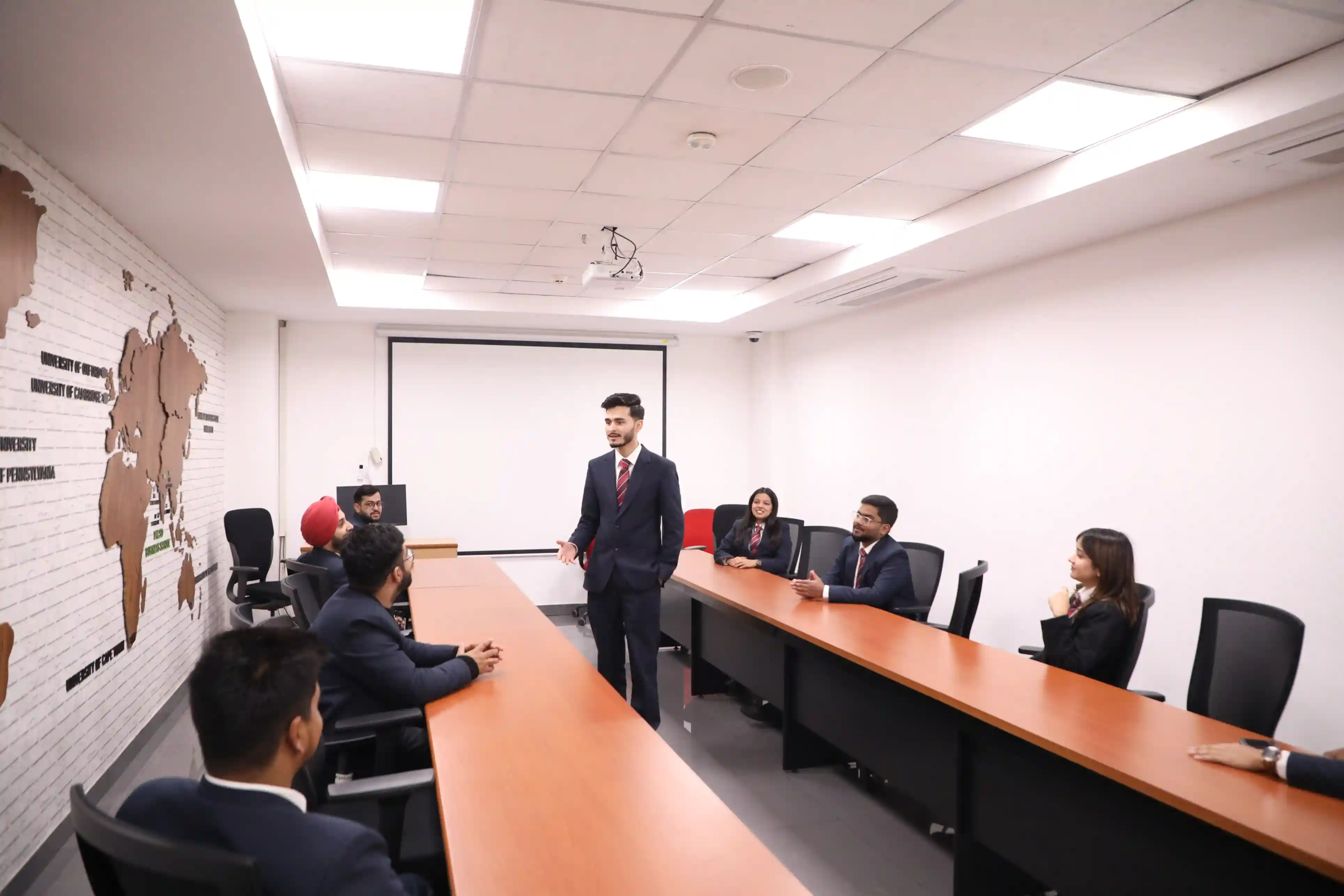
At PML SD Business School, the programme focuses on management education supported by practical learning and value-based professional development.
The school’s institutional overview explains its academic mission and PGDM offering.
What Is a PGDM Course and What Does It Include?
A PGDM course combines foundational business subjects, specialisation-oriented learning, and opportunities to apply management concepts.
Students typically study business functions before developing deeper knowledge in their preferred management areas.
At PML SD Business School, the published curriculum includes management subjects and elective groups covering Finance, Marketing, Human Resources, Analytics, Operations and Entrepreneurship.
Practical Learning at PML SD Business School
The institution’s documented teaching approach includes:
- Case discussions and group presentations.
- Management games and group activities.
- Practical assignments and live projects.
- Industry-oriented learning activities.
- Learning Lab sessions focused on professional development.
These activities help students connect theoretical concepts with workplace situations.
Read More: Explore the PGDM Course Curriculum at PML SD Business School
What Is the Eligibility Criteria for PGDM Admission in India?
PGDM eligibility generally requires a recognised bachelor’s degree, although minimum marks and entrance-test requirements vary by institution.
For PML SD Business School’s published 2027- 29 admission cycle, applicants must have a bachelor’s degree with at least 50% marks or equivalent CGPA.
The qualification must meet the recognition and minimum-duration conditions stated in the admission brochure.
Students from Commerce, Science, Arts, Engineering and other eligible academic backgrounds may apply.
The published selection process includes:
| Admission Component | PML SDBS Requirement |
| Academic qualification | Recognised bachelor’s degree |
| Minimum marks | 50% or equivalent CGPA |
| Accepted entrance tests | CAT, XAT, CMAT, MAT, ATMA or GMAT |
| Additional assessments | Written Ability Test and Personal Interview |
Final-year undergraduate students may also apply, subject to conditions.
Meeting minimum eligibility does not guarantee admission.
What Is the Duration of a PGDM Course?
A full-time PGDM commonly lasts two academic years, although programme structures can vary.
PML SD Business School offers a two-year, full-time PGDM organised through a trimester system.
A trimester system divides an academic year into three terms, allowing subjects, and assessments to be organised across shorter teaching periods.
Students progress from foundational management learning towards advanced subjects and specialisation electives.
The programme’s published approach also includes practical assignments and summer internship opportunities.
When comparing PGDM colleges in Chandigarh, students should examine the complete academic structure rather than choosing solely on duration.

What Subjects Are Covered in the PGDM Course Syllabus?
A PGDM syllabus generally covers core business functions, analytical skills, management principles, and specialisation-related subjects.
Common subject areas include:
| Subject Area | What Students Learn |
| Marketing | Customer behaviour, sales, and markets |
| Finance | Accounting, financial decisions, and budgeting |
| Human Resources | People management and organisational behaviour |
| Operations | Processes, productivity, and resource planning |
| Business Analytics | Data interpretation and business decisions |
| Economics | Markets and the business environment |
| Strategy | Competitive decisions and organisational direction |
Technology-Oriented Learning
PML SD Business School’s published 2027- 29 curriculum includes Information System & Analytics electives such as Python Applications in Business, Data Visualisation and Predictive Analytics.
These subjects illustrate how management education can incorporate digital and analytical capabilities.
Individual elective availability is subject to institutional conditions and student demand.
Students can compare the subjects listed in the official curriculum with their preferred career direction.
What Is the Difference Between PGDM and MBA?
The main difference is that PGDM is a postgraduate diploma, while MBA is a master’s degree.
Both qualifications can offer management education, but their recognition and academic frameworks differ.
| Factor | PGDM | MBA |
| Qualification | Postgraduate diploma | Master’s degree |
| Awarding institution | Institution offering the approved programme | Authorised degree-granting institution |
| Curriculum | Depends on institution | Depends on university and programme |
| Practical learning | Varies by programme | Varies by programme |
| Career opportunities | Depend on skills and employers | Depend on skills and employers |
Why Consider an AICTE-Approved PGDM?
A PGDM may appeal to students seeking professionally relevant electives, practical projects and management-focused learning.
PML SD Business School combines its published management specialisations with case-based teaching and technology-related subjects.
However, an AICTE-approved PGDM is not automatically equivalent to an MBA degree. Students requiring equivalence for government employment or higher studies should verify it separately.
Read More: MBA vs PGDM: 7 Critical Differences Every Management Aspirant Must Know
What Are the Best PGDM Specialisations to Choose From?
The best PGDM specialisation depends on a student’s interests, strengths and intended career path.
PML SD Business School’s published specialisation areas include:
| Specialisation | Suitable Interests |
| Finance | Financial analysis and decision-making |
| Marketing | Customers, brands and sales |
| Human Resource Management | Recruitment and people management |
| Information System & Analytics | Data and business technology |
| Operations & Supply Chain Management | Logistics and process improvement |
| Entrepreneurship & General Management | Business creation and management |
For example, a student interested in customer behaviour may explore Marketing, while someone who enjoys quantitative analysis may consider Finance or Analytics.
No single specialisation guarantees better employment or salary outcomes.
Read More: How to Choose the Right PGDM Specialization: A Step-by-Step Decision Framework
What Is the Average Fee Structure of a PGDM Course in India?
There is no single reliable average PGDM fee that applies to every institution in India.
Fees vary according to the institution, programme structure, included services and location.
PML SD Business School’s published fee structure lists a total programme fee of ₹8,00,000, covering tuition and specified institutional services.
Students should additionally budget for accommodation, travel, personal expenses and financing costs where applicable.
For applicants from Chandigarh and the Chandigarh Tricity, living at home may reduce relocation expenses.
Before enrolling, compare the complete cost with your family’s financial circumstances and the programme’s learning opportunities.
Review the official PML SD Business School fee structure and confirm charges applicable to your admission batch.
What Career Opportunities Are Available After Completing PGDM?
PGDM graduates can explore business and management roles according to their specialisation, skills, and employer requirements.
Potential career directions include:
- Finance: Financial analysis, banking and corporate finance.
- Marketing: Sales, market research and brand-related roles.
- Human Resources: Recruitment, HR operations and talent development.
- Analytics: Business analysis and reporting.
- Operations: Process management and operational coordination.
- Supply Chain: Procurement, logistics and planning.
- General Management: Business development and cross-functional roles.
PML SD Business School provides summer internship opportunities and placement assistance as part of its management education approach.
Students should examine published placement information, internship experiences, and the types of roles available rather than relying on isolated salary claims.
Read More: Explore Placement and Internship Information at PML SD Business School
Is PGDM Worth Pursuing for a Successful Management Career?
A PGDM can be worthwhile when the programme’s academic quality, practical learning, and career relevance justify its overall cost.
A smart decision should consider approval, curriculum, faculty, specialisations, teaching methods, internships, and financial affordability.
Why Explore PML SD Business School, Chandigarh?
PML SD Business School offers several documented features worth considering:
- A two-year, full-time, AICTE-approved PGDM.
- A trimester-based academic structure.
- Six published management specialisation areas.
- Analytics and technology-related electives.
- Case discussions, practical assignments and live projects.
- Learning resources and career-support activities.
Located in Sector 32C, Chandigarh, the institution is geographically accessible to many aspirants from the Chandigarh Tricity and nearby parts of Punjab.
These features make it a relevant PGDM option to evaluate, although career success ultimately depends on individual effort, programme fit, and employer opportunities.
Conclusion
Beginning with PGDM full form and course details understanding, can help students make informed decisions about management education.
PGDM stands for Post Graduate Diploma in Management. Its value depends on the programme’s academic structure, approval, specialisations, practical learning, and career relevance.
For aspirants from Chandigarh, Mohali, Panchkula and Punjab, PML SD Business School, Chandigarh, offers an AICTE-approved PGDM with a trimester-based curriculum, management electives and experiential learning activities.
Students and parents should compare programmes carefully before deciding.
Explore PML SD Business School’s PGDM curriculum, review the admission requirements, and contact the institution for guidance on your management education options.
Frequently Asked Questions (FAQs)
1. What Is the Full Form of PGDM?
PGDM stands for Post Graduate Diploma in Management, a postgraduate-level management qualification.
2. What Is the Duration of PGDM at PML SD Business School?
PML SD Business School offers a two-year, full-time PGDM organised through a trimester system.
3. Can Arts and Science Graduates Apply for PGDM?
Yes. Eligible graduates from Arts, Science, Commerce, Engineering, and other academic backgrounds can apply.
4. Is PGDM the Same as an MBA?
No. PGDM is a postgraduate diploma, while MBA is a master’s degree.
5. Is PML SD Business School’s PGDM AICTE-Approved?
Yes. The institution publishes its AICTE approval and extension documents on its official website.
6. Does PGDM Guarantee a Job After Graduation?
No. Employment depends on individual skills, experience, employer requirements, and available opportunities.